We’re not afraid of AI. We’re afraid of our own Apathy
The experts are all proclaiming it. I hear it across all my podcasts while lifting at the gym, doing errands in the car, while washing dishes at night. This past week I’ve heard the same thing over and over again. AI is here, most just don’t know it yet. So many jobs are gone, even if layoffs haven’t started. It can do what a lawyer/CPA/developer/human does, but faster. Or my personal favorite: My AI assistant does X while I sleep.
College students are outsourcing their essays. Companies are cutting copywriters, graphic designers, even engineers. AI has already become recursive. It’s surpassed humans, the economy just hasn’t corrected yet. It makes me wonder if my dream career is over.
I want to make a living as a writer and photographer. It’s what I love to do. But I hear a lot of smart, respectable people saying some semblance of those words. Is a writing career no longer viable? Is photography a bygone art?
Matt Shumer’s viral essay this week declares as much: “The experience… of watching AI go from ‘helpful tool’ to ‘does my job better than I do,’ is the experience everyone else is about to have. Law, finance, medicine, accounting, consulting, writing, design, analysis, customer service… The people building these systems say one to five years. Some say less… I think ‘less’ is more likely.”
This is on top of all the other uncertainty in the world. Political and economic upheaval, alarming geopolitical drama, the ambiguous precipice of automation. It feels like there’s a collective, unspoken agreement that the world will not be the same. That the world we knew and all agreed upon is changing before our eyes, in real time, faster than we can process or comprehend or appreciate it. That we’re basically powerless to stop or affect it. And that’s downright scary.
That’s how I often feel when I reflect on the world and my place in it. When I consider how I can make my mark, fulfill my purpose… even make a living. Is writing a dead-end career now? Are real photographs actually necessary anymore? My psyche in two words: scared shitless.
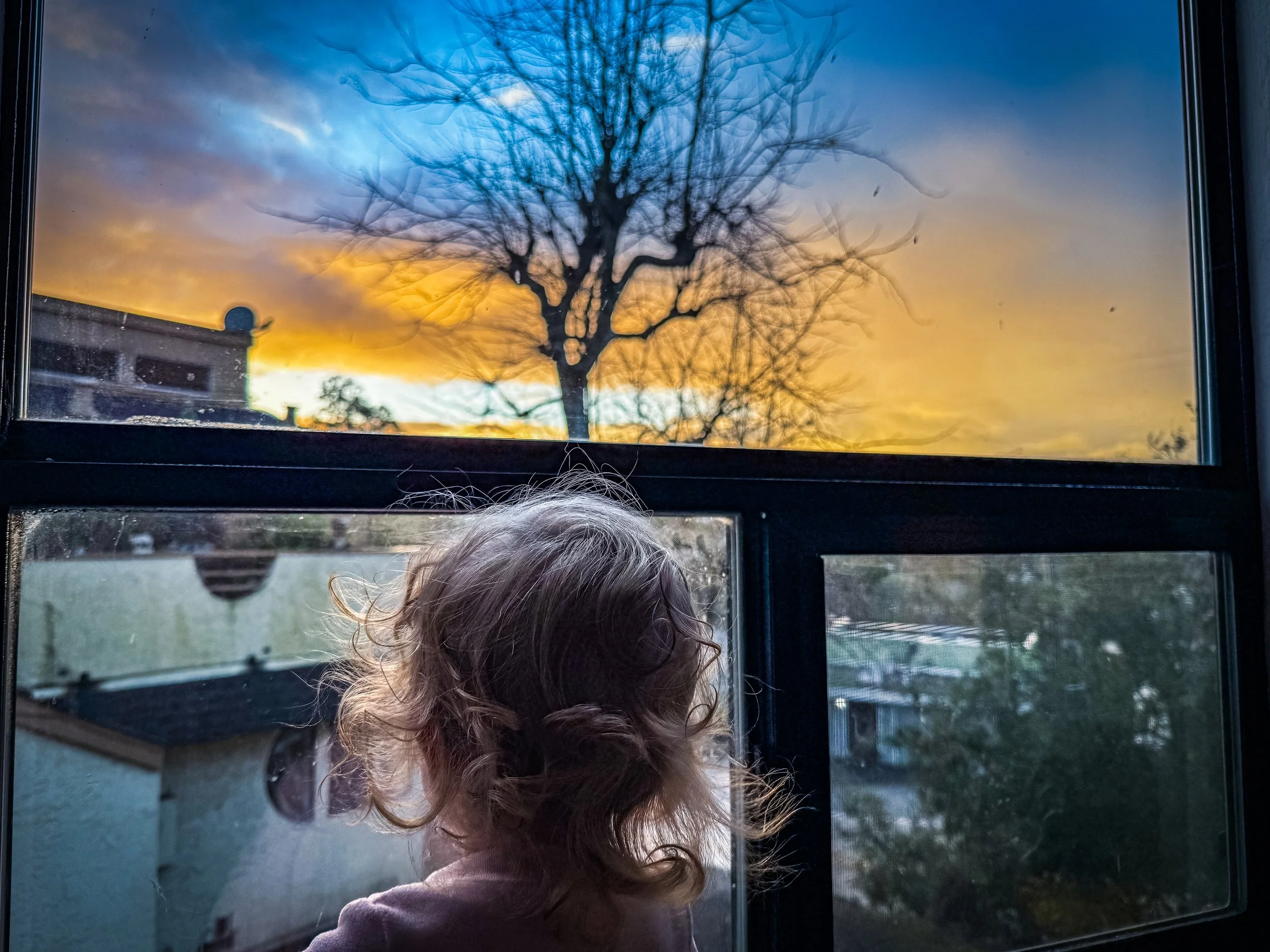
Then I think about my daughter, who just turned one, happily scurrying across the floor from toy to toy, reveling in the pure joy of carefree freedom with reckless abandon. What kind of world will she inherit? How will she make a living? We’re doing our best to raise a strong, smart thinker, but it’s hard to predict what will be important for her education. What skills should we focus on? Coding? Analytical thinking? Simply resilience? What happens if there are simply no more viable jobs? What if it’s not ‘if’ but ‘when’?
Ben Affleck recently pushed back on this on JRE: “I actually don’t think it’s… going to be able to write anything meaningful… the technology is not progressing in exactly the same way they sort of presented it and really what it is going to be is a tool…” He also cites the concerns over cost and energy requirements versus output. AI’s improvement curve may already be flattening. Each new model costs exponentially more energy for only marginal performance gains. The early growth line shot upward, but now it’s leveling. Maybe the AI revolution will be incremental.
Sure, Ben Affleck is an actor/filmmaker. I doubt he’s more technical than you or I, so his view, like everyone else’s, should be taken with a grain of salt. But I do believe he and Matt Damon are two smart people with expertise in their industry who are rigorously and honestly evaluating AI’s impact on their space. Then again, they’re already rich, so maybe it’s arguable they can afford to be cavalier and dismissive.
What about someone less rich but better positioned in the space? Cal Newport is an actual computer scientist. In both his essays on his website and on his podcast he regularly refutes the hype around AI, such as his workforce essay from January: “AI agents failed to live up to their hype. We didn’t end up with the equivalent of Claude Code or Codex for other types of work. And the products that were released, such as ChatGPT Agent, fell laughably short of being ready to take over major parts of our jobs.” Reading quotes like this from someone who studied algorithms at MIT allows me exhale a little bit. I hope Ben and Cal are right.
Yes AI is scary. But I believe we’re collectively holding our breath because we’re scared about our humanity, not the technology itself. Most laypeople like myself don’t understand it technically. We don’t know the differences between supervised and unsupervised learning or what deep learning and reinforcement learning really means as they pertain to AI. But we feel the malaise and dread. Not just in AI, but in every sphere of society. The chaos isn’t isolated to AI and Big Tech, it’s all around us in the housing market and cost of living, in our leadership and government. We’ve had serious problems before AI came along, and they’ve been bubbling to the surface for a while now. Maybe AI is the straw that breaks the camel back—we fear not just that it will replace us, but that AI represents our loss of value, our loss of purpose, a loss of meaning. Maybe the AI hype makes us feel we’ve lost our way and can’t gain it back.
I know one thing for sure. Our salvation is not AI. It is ourselves. Our empathy and humanity are what will save us from ourselves, not an artificial technology. I believe in the power of humanity. I believe humans can be kind and amazing and terrible and good and intuitive and beautiful. How well we organize is what will determine our fate. Tommy Lee Jones has this line from the first Men in Black movie that has always hit me: "A person is smart. People are dumb, panicky, dangerous animals, and you know it."
I reject that. We may be dumb animals sometimes. But we’re also capable of so much more. What separates our species is our ability to organize. Look at the world humans have built. Sometimes it’s messy and unfair and disturbing, but there is less suffering than ever before. See Steven Pinker’s work. We must reject apathy in the face of disorder and uncertainty. Maybe the world is changing faster than we’re able to process. That means we must look deep within our humanity to change the world. Things like supporting human art, even if imperfect. Prioritizing our relationships over entertainment and consumption. Teaching our children to think critically and empathetically. Organizing along our shared humanity instead of tribal differences. We can do all of this. We can refuse to give into our fear. We can take action.
AI isn’t deciding our future. We are. Through our attention. Through our organization. Through global consciousness. Through what we teach our children, and what we build for them. So that they grow up in a world with AI, but without apathy.